

Suzuki Swift Proves Small Cars Can Achieve 1,000km Range
4 May, 2026
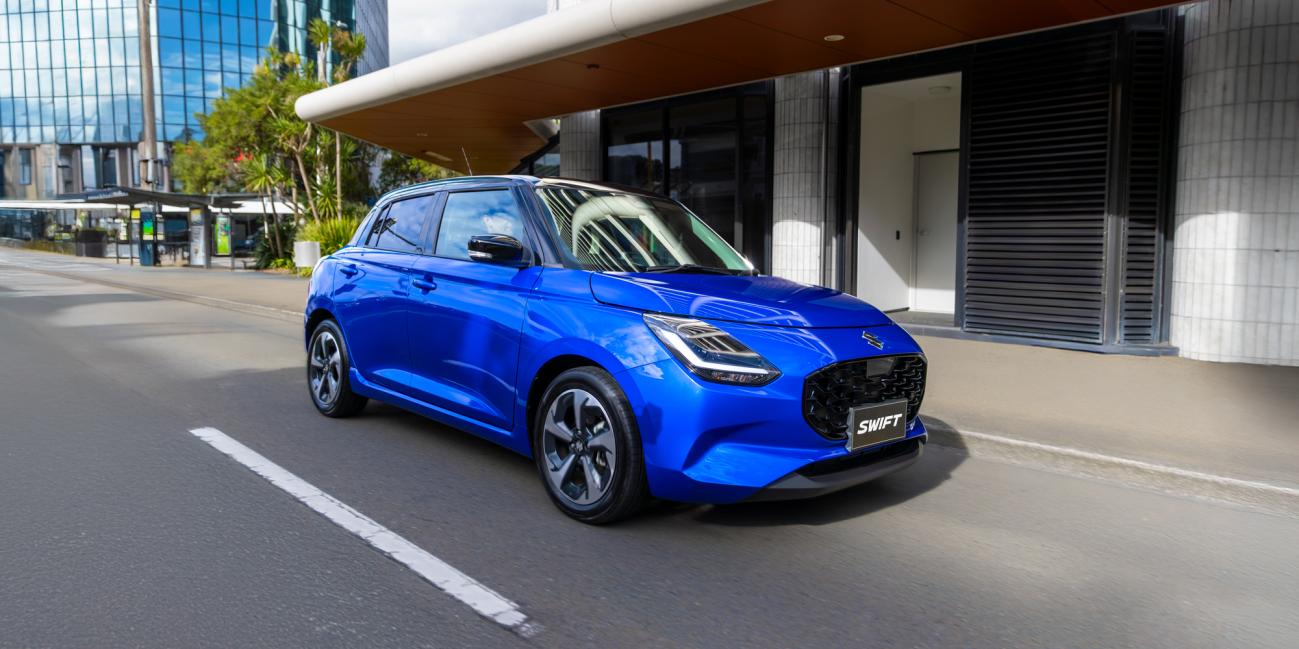
Suzuki Swift Proves Small Cars Can Achieve 1,000km Range
The latest fourth generation Suzuki Swift has proved a real petrol saver in an independent fuel economy test conducted on North Island roads.
A 1.2 litre petrol/electric Swift GLS CVT automatic achieved a remarkable average fuel consumption of 3.3 litres/100 kilometres over a mixture of motorway, rural open roads and built-up city streets – a 23 percent improvement over the official factory figure of 4.3 litres/100 km (3P-WLTP).
The petrol/electric Swift GLS manual gearbox version did even better with an average of 3.0 litres/100 km in the local fuel testing. This was 25 percent more frugal than this version’s factory figure of 4.0 litres/100 km.
This equates to a driving range of 1,233 kilometres for the manual GLS Swift and 1,121 kilometres for the GLS automatic, based on the standard 37 litre fuel tank.
Both tests were carried out by Donn Anderson who has been involved in fuel economy events for more than 30 years and drove in record-breaking runs in Britain and New Zealand. “While the average driver maynot achieve these outstanding driving ranges on a tank of fuel, it does demonstrate how remarkably economical the vehicle can be when driven moderately and with care” said Anderson.
The latest Swift boasts a relatively high compression ratio of 13.9:1 and better thermal efficiency than the previous 4-cylinder equivalent with an identical capacity of 1,197 cm3. The power unit with variable valve technology and four valves per cylinder has fewer components, is lighter and has reduced friction losses that all contribute to the outstanding fuel economy.
The test route, which began and ended in Auckland, encountered heavy traffic and road works disruption that necessitated frequent stop/start driving. When these hold-ups were encountered, the Swift’s engine shut down and restarted automatically which proved a useful advantage.
Suzuki’s integrated starter generator (ISG) that replaces a conventional alternator reduces fuel consumption by providing supplementary motor power for up to half a minute. ISG uses the energy of deceleration to generate electricity for charging both the lead-acid battery and the lithium-ion battery.
It also functions both as a generator and electric motor to restart the engine and provide electric motor assistance during acceleration. The ISG monitors brake pedal depression during deceleration to maximise the level of regeneration.
“The engine stopping and restarting is almost imperceptible,” said Anderson. “Restarting is via a belt drive system that eliminated gear noise produced by conventional starter motors. Occupants are usually unaware the motor has stopped and then restarted.”
Anderson said he concentrated on decelerating as much as possible to conserve fuel and found the new, larger information screen a valuable asset in reducing fuel consumption. Within the instrument cluster a discreet symbol illuminates when the lithium-ion battery is charging during deceleration, while the central mounted screen details both average, instant fuel consumption and fuel economy history.
“Increased low-speed torque and enhanced combustion assists in the easy-going nature of the engine in the latest generation Swift,” said Anderson.
The new continuously variable transmission (CVT) in the latest Swift is lighter and more compact than its predecessor with an infinite number of possible ratios available. It proved both smooth and flexible on the fuel economy run, displaying an ability to cruise at 100 km/h with the engine turning at little more than
2,000 rpm.
Anderson said the performance of the 5-speed manual gearbox Swift was also highly creditable. “There are now so few manual transmission cars available but the GLS manual is a fine exception with its refined gearbox that is quiet and easy to use with its light action. The 3.0 litres/100 km economy achieved is an exceptional result for a mild Hybrid car and confirms there is still a place for the manual gearbox,” he said.
While using less fuel, the new Swift range is also cleaner running with lower CO2 emissions. The 96 grams/km CO2 official result for the Swift GLS CVT is 9.4 percent lower than the outgoing third generation non-hybrid model.
The Suzuki Swift is New Zealand’s most affordable hybrid model priced from $25,990 + ORCs, with the CVT automatic range beginning from $27,500 on the current promotion.